Hawaii Boating Laws and Regulations
Carry the Card
Vessel operators who are required to have a Boater Education Card must carry the card on board the vessel and have it available for inspection by an enforcement officer.
Penalty: Not carrying your Boater Education Card when one is required can result in a fine.
Reciprocity
For visiting boaters, all states, territories, and provinces will recognize boating education cards that meet NASBLA requirements and Canadian Pleasure Craft Operator Cards that meet Transport Canada’s requirements. (This is known as “reciprocity.”)
Age and Education
Boating Safety Education Course
HAR 13-244-15.5 (a) Operation of power driven vessels: Any person operating a power driven vessel on the waters of the State shall be required to possess a certificate of completion from a National Association of State Boating Law Administrators (NASBLA) approved course on the safe use and operation of a power driven vessel that contains a component on Hawaii waters approved by the department. Exemptions to this rule exist for persons who:
- possesses a current merchant mariner credential
- operate a thrill craft in a commercial thrill craft zone
- operate a motor vessel that is ten horsepower or less, or
- are on a voyage originating outside the State and remain in Hawaii less than sixty days
HAR 13-244-15.5 (b) Boating Age Restriction: A person under sixteen years of age shall not operate a power driven vessel on the waters of the State unless:
- You hold a NASBLA & Hawaii approved boating safety certification, and
- You’re directly supervised onboard by an adult (21+) who also holds the same certification
Thrill Craft Education Course
*Hawaii refers to Personal Watercrafts (PWCs) as Thrill Craft. The definition of “thrill craft” is any motorized vessel that falls into the category of a personal watercraft and which:
- Is generally less than 13 feet in length as manufactured;
- Is generally capable of exceeding a speed of 20 miles-per-hour;
- Can be operated by a single operator, but may have the capacity to carry passengers while in operation;
- Or is designed to provide similar operating performance as a personal watercraft through a combination of size, power plant, and hull design.
HAR 13-256-16 (d) Thrill craft operations; general provisions: Effective January 2005, all recreational thrill craft operators shall be required to possess, and make available upon demand of enforcement personnel, a certificate of completion from a state-approved course on the safe use and operation of a thrill craft. The State may recognize reciprocity with other states, i.e., the NASBLA-approved portion of the personal watercraft course; however, all operators shall be required to complete the portions of a certificate course for Hawaii that includes, but is not limited to:
- Local ocean safety principles and practices;
- The historical, cultural, and customary practices of Hawaii 's ocean users; and
- Any rules or laws pertaining to protected species and thrill craft operation in the State.
The Boating Safety Education course is a required prerequisite to the Thrill Craft course.
HAR 13-256-16 (a) Thrill Craft Age Restrictions: No person under fifteen years of age shall operate a thrill craft. No person shall permit, or mislead another person into permitting, a person under fifteen years of age to operate a thrill craft.
Tow-In Surfing Course
13-256-22 (f) Tow-in surfing: Effective September 1, 2004, both the thrill craft operator and surfer, who engage in, or operate a thrill craft for tow-in surfing, shall be required to possess, and make available upon demand of enforcement personnel, a certificate of completion from an accredited institution of higher education in Hawaii on the safe use and operation of a thrill craft in high surf, that includes but is not limited to:
- Local ocean safety principles and practices;
- Hawaii Administrative Rules as they apply to boating;
- The historical, cultural, and customary practices of Hawaii 's ocean users; and
- Any rules or laws pertaining to protected species and thrill craft operation in the State.
The Boating Safety Education course and Thrill Craft course is a required prerequisite to the Safe use and Operation of a Thrill Craft in a high surf course.
All vessel operators (& tow-in surfers) must carry their boating safety certificate or card while operating just like you’re required to carry a driver’s license when driving a car.
It is the responsibility of the operator to stay informed of changes in boating safety or operation requirements. This is a basic boating course and additional boating education may be required to operate a recreational boat safely.
For information about registering for a course or certification requirements, visit: https://dlnr.hawaii.gov/dobor/
Boat Registration and Titling Requirements
Motorboat Definition
HAR 13-230-8 Motorboat: “Means any vessel sixty-five feet in length or less which is equipped with propulsion machinery including steam and includes wet bikes, motorized surfboards and any other vessel propelled by a motor engaged in towing discs, boards, parasails or any other devices which may be towed. This term includes a vessel temporarily or permanently equipped with a motor.” (Motorized vessel)
Registration
HAR 13-241-2 Vessel numbering and titling requirements; operation of certain vessels prohibited: In Hawaii all motorized vessels must be registered annually with the following exceptions:
- Recreational vessels properly documented with the U.S. Coast Guard
- U.S. government owned vessels
- A vessel’s lifeboat used solely for lifesaving purposes
- Manually propelled recreational vessels
- Recreational vessels eight feet or less in length propelled solely by sail
- Motorboats used exclusively for racing
- Vessels registered in another state visiting Hawaii less than sixty days
- Foreign vessels visiting Hawaii less than sixty days
Every new or previously registered commercial or recreational vessel operating on the waters of the State of Hawaii is required to be registered or documented with either the Department of Land and Natural Resources, Division of Boating and Ocean Recreation (DLNR/DOBOR) or the U.S. Coast Guard. Commercial vessels holding a valid marine document may also be required to obtain an annual commercial decal.
Certificate of Number (Registration)
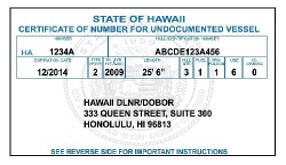
Once a vessel is registered the owner will receive a Certificate of Number which must be kept aboard the motorized vessel at all times and be readily available for inspection by a law enforcement officer. It is required to operate.
The Certificate of Number and validation decal are good for one year!
Vessel Decal
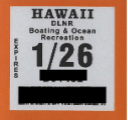
Motorized Vessels must display their registration stickers and registration numbers (beginning with HA):
- Stickers shall be on the forward half of your vessel well above the waterline so it is visible from a distance and can be easily read by law enforcement officials.
- Letters and numbers are to be block style of at least 3" tall.
- Letters and numbers must be black or another color that contrasts with the hull.
- Letters and numbers are to read from left to right and have a space or hyphen to separate letters and numbers.
- The validation decal must be affixed within three inches aft and in-line with the registration letters and numbers.
- Expired registration stickers must be removed or covered with the new sticker.
- Decal lettering and numbers are not provided by DLNR/DOBOR, you must purchase these on your own from any hardware/craft store.
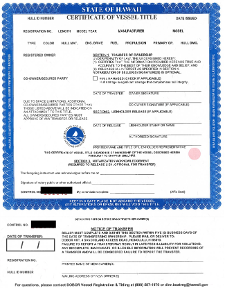
In Hawaii a motorized vessel owner is required to report the change of ownership, address, and destruction or abandonment of a vessel within seven days.
Hull Identification Number (HIN)
A hull identification number (HIN) is required on every vessel. No vessel manufactured after January l, 1967 may be sold or offered for sale unless the vessel has a HIN (HAR §13-244-23). No person shall willfully deface, destroy, remove, or alter the vessel hull identification number which is carved, burned, stamped, embossed, or otherwise permanently affixed to the hull of a vessel by the manufacturer, or by the owner in the case of restoration, for the purpose of identifying the hull.
Defacing a HIN and possessing a vessel with an erased or mutilated HIN is prohibited by the Hawaii Revised Statutes and the Hawaii Administrative Rules.
Titling
Hawaii is a Title State according to Hawaii Revised Statute 200A-7. Vessels will be issued a title by the Department of Land and Natural Resources, Division of Boating and Ocean Recreation.
Ramp Decal & Trailer Registration
- In Hawaii, trailer registration stickers for boat trailers are not governed by DLNR/DOBOR but handled by the county Department of Customer Services (DMV).
- To use a DLNR/DOBOR launch ramp you must purchase a launch ramp decal for your trailer annually.
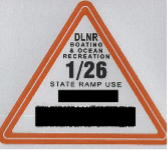
For more information regarding decal replacement/purchase, cost, and registration, visit: https://dlnr.Hawaii.gov/dobor/
Equipment Requirements
Equipment
HAR 13-243-1 (a) Equipment required by vessels on state waters: This chapter applies to all vessels that are propelled or controlled by machinery, sails, oars, paddles, poles, or another vessel, except Hawaiian design racing canoes, racing shells, rowing sculls, and racing kayaks:
- Navigational lights
- sound-producing devices
- personal flotation devices
- ventilation
- backfire/flame control
- distress signals
Must conform to standards in, U.S. Coast Guard Navigation Rules, COMDTINST M16672.2B (Aug 17, 1990), U.S. Coast Guard Boating Standards Manual, COMDTINST M16761.2B (Mar 26, 1991), 33 CFR Parts 175, 177, 181, 183, 46 CFR Part 25 (as of Oct 1, 1992).
Thrill craft are boats too and must follow all equipment requirements for a Class A Vessel.
Life Jacket Age Requirements and Recommendations
HAR 13-243-1 (b) & (C) Personal Flotation Device (PFD) Life Jacket:
- Children under 13 must wear a properly fitted life jacket when a recreational vessel is underway or anchored offshore unless they're below deck or in a cabin.
- All thrill craft operators and passengers must wear life jackets at all times regardless of age.
In addition to federal requirements, Hawaii recommends that everyone on board wear a properly fitting, U.S. Coast Guard-approved life jacket, regardless of age.
- One PFD is required for every person on board.
- Life jackets should fit snugly and be inspected regularly for damage (punctures, fading, chafing).
- Store them away from sunlight, fuel, and oil.
- Don’t use PFDs as seat cushions or fenders.
- Encourage children to wear life jackets early adults should set the example.
Everyone on a personal watercraft or being towed must wear a Type I, II, III, or V PFD. Note: Inflatable PFDs are not allowed for tow sports or high-impact activities.
Laws for Carriage or Use of
The following items are recommended depending on how and where you use your boat:
- Compass and charts
- Marine VHF radio (regardless of miles offshore)
- Anchoring equipment
- Bailing device
- Spare parts & tools
- Extra starting battery
- Oars or paddles
- Flashlight (waterproof recommended)
- Batteries for all electronic devices
- Battery cover
- Ditch bag
- Emergency food and water supply
- Personal emergency position indicating radio beacon (regardless of miles offshore)
- First aid kit
- GPS device
- Leashes for oars/paddles
- Additional marine whistles
- Mirror or another reflective device
- Parachute/bucket and 100' of line
- Spare fuel filters
- Spare kill switch
- Strobe light
- Dive flag
Engine Cut-Off Switch (ECOS)
If your vessel is equipped with an ECOS, you are required to use it while operating above idle speed. The lanyard must be attached to the operator at all times during operation. This applies to both thrill craft and motorboat operators. If your vessel was not manufactured with an ECOS, you are not required to install or use one. This is a federal regulation that Hawaii must follow.
EPIRB and VHF Radio
HRS 200-37.5 Emergency Communication Devices: Hawaii requires all recreational vessels going more than one mile offshore to be equipped with a USCG approved Emergency Position Indicating Radio Beacon (EPIRB) (406 MHz) or a VHF radio. Thrill craft, surfboards, paddleboards, kayaks and training vessels are exempt.
Marine Environment and Noise
Federal and State pollution laws are meant to protect our stream and ocean environments for all users. Mālama i ke kai (Care for the ocean)
Spills–Proper Disposal–Littering
- Polluting Hawaii's waters with a petroleum product, hazardous material, or sewage is a violation of the State water quality standards established by the Hawaii Department of Health. Violators may be fined up to $10,000 for each day of violation.
- All boats that have onboard toilet facilities must have a method to collect and contain all waste products, preventing it from entering surrounding waters. It is illegal to discharge sewage, treated or untreated, or any waste derived from sewage into the waters of a small boat harbor within the State jurisdiction of Hawaii.
- It is also illegal to pollute the ocean waters or shores with litter, sewage, or other gaseous liquid or solid materials.
HAR 13-243-2 Marine sanitation devices: All installed MSDs must be US Coast Guard certified and have a "Y" valve in proper positioning.
33 CFR §155.450 (oil) and 33 CFR §151.59 (garbage) discharge: It is illegal to dump oil or garbage into any Hawaii state waters! Discharging fuel, oil, or oily bilge water is strictly prohibited.
Vessels 26 feet or longer must display:
- A 5" x 8" “Discharge of Oil Prohibited” placard near the bilge pump switch or in the engine room.
- A 4" x 9" “Discharge of Garbage Prohibited” placard in a visible spot for crew and passengers when operating in federal waters.
Hawaii’s Coral Reefs
The first Hawaiians saw the importance of corals and the coral reef as a major component to our islands. Coral reefs are the largest continuous living structures on earth and composed of individual coral animals called polyps. These polyps, smaller than the head of a pin, were the first creatures to emerge in the Kumulipo – the traditional Hawaiian account of creation.
Coral reefs present many benefits to our islands by providing protection from dangerous waves and storm surges, producing beautiful white sandy beaches since most of the sand comes from the reef. The reefs provide habitat and shelter for fish and other marine life. Hawaiians were intimately aware of the life cycles of marine resources. They understood the sustainability of the resources because their existence depended on it.
Today, the coral reefs are just as vitally important, and we all should do our part to care for them by:
- Educating yourself on protecting coral reefs and sharing the knowledge with others;
- Inspecting your clothing and gear before entering the water for fragments of invasive marine organisms;
- Obeying all signs posted, especially those posted in marine protected areas. They’re there to protect you and the resources;
- Picking up trash, even if it is not yours. Trash can damage and kill a wide variety of marine life;
- Leaving coral, shells, sand and rocks where they lay. They provide valuable resources for marine life including shelter, homes and even food;
- Keeping your swim fins, gear and hands away from coral. No standing on coral;
- Using existing moorings or anchoring in the sand. Dropping anchors on live reefs are illegal and damages coral;
- Picking up abandoned fishing gear (nets, lines, hooks, sinkers). They can injure marine life and humans.
Day Use Mooring
The purpose of the Day Use Mooring rules and zones is to reduce damage to coral and other marine life as a result of continuous use of anchors by commercial and recreational vessels in zones of high diving and mooring activity. The rules describe the provisions for mooring at State Day Use Mooring buoys and the zones where the buoys are located (HAR §13-257). In general:
- no permit is required;
- moorings are for daytime use only;
- there is a limit of 2.5 hours if another vessel is waiting (except Old Kona Airport MLCD where vessels are prohibited);
- anchoring within 100 yards of a Day Use Mooring is prohibited except where no live corals exist;
- separate Day Use Moorings exist for recreational and commercial vessels at Molokini Atoll;
- vessel owner or operator assumes sole risk of using the mooring.
Grounded, Abandoned, or Derelict Vessels
All boaters should keep their vessels well maintained to prevent mechanical failures or sinkings that could impact live corals. Post a lookout to help you navigate through shallow areas. If you do experience engine failure and are about to go aground, deploy your anchor to stop your drifting.
- Grounded vessels must be removed immediately by the owner at their own expense. If grounded on sand or mud and not at risk of breaking up, removal must occur within 72 hours, unless otherwise approved.
- Owners are fully responsible for any damage to State or private property.
- A vessel left unattended for over 24 hours may be deemed derelict if it poses a sinking, obstruction, or safety risk.
- Removal costs can exceed $25,000, depending on location and conditions.
- Insurance is required for vessels 26 feet or longer, with $100,000 minimum coverage, ensuring removal and salvage are included. Proof must be shown on request.
Hawaii’s Protected Species
Hawaii also protects marine ecosystems through Marine Managed Areas (MMAs), Marine Life Conservation Districts (MLCDs), and others. These may limit or prohibit motorized vessels, anchoring, or fishing. Boaters must research area rules before entering.
Learn more: https://dlnr.Hawaii.gov/dar/marine-managed-areas/
Protection of Marine Species: All marine mammals and sea turtles are protected by Federal and State law. An overview of this protection is provided below.
MMPA and ESA: Under Federal law, all marine mammals are protected under the Marine Mammal Protection Act (MMPA). Some marine mammals, including humpback whales, sperm whales, false killer whales and Hawaiian monk seals, are also protected as endangered species under the Federal Endangered Species Act (ESA). Sea turtles are also protected under the ESA. The National Marine Fisheries Service (NMFS), an agency within NOAA, is responsible for administering the MMPA and ESA.
National Marine Sanctuaries Act: Humpback whales are protected in the Hawaiian Islands Humpback Whale National Marine Sanctuary under the National Marine Sanctuaries Act (NMSA). The sanctuary is co-managed as a Federal-State partnership by the Hawaii Department of Land and Natural Resources and NOAA, National Ocean Service, Office of National Marine Sanctuaries.
Hawaii State Law HRS 195D and HAR 13-124: Marine mammals and sea turtles listed as endangered or threatened species, including humpback whales, sperm whales, false killer whales, Hawaiian monk seals, and all species of sea turtle, are protected under HRS 195D and HAR 13-124.
Monk Seals: Hawaiian monk seals are native and found only in the Hawaiian Islands. Most live in the Northwest Islands, but sightings in the Main Islands have increased since the early 1900s. They remain endangered due to population decline. Monk seals eat bottom-dwelling creatures like eels, octopus, and crustaceans—not pelagic fish like mahi-mahi or tuna. They help keep the reef ecosystem balanced. Do not feed seals or throw bait scraps in the water near them, as this can lead to dangerous interactions or accidental injuries.
Humpback Whales: By law, people must stay at least 100 yards away from humpback whales in Hawaiian waters. This applies to all ocean users. Researchers with special permits may get closer. If a whale approaches you, stay still and wait for it to leave. If in a motorboat, put the engine in neutral but don’t turn it off. Learn more at: Hawaiihumpbackwhale.noaa.gov
Disturbing Protected Species: Except for humpback whales, there’s no fixed legal minimum distance for marine mammals or turtles but disturbing them or feeding them is illegal. For safety and protection, NOAA and DLNR recommend staying at least 150 feet away from marine mammals and turtles and avoiding swimming with wild dolphins. Use binoculars or zoom lenses to watch wildlife without disturbing them. More info: NOAA Marine Life Viewing Guidelines
If you see an injured or distressed marine animal, report it immediately this can save lives:
- Hotline for fishery interactions and marine mammal incidents: 1-888-256-9840 (24/7)
- NOAA Enforcement Hotline for violations: 1-800-853-1964
Muffler Noise
HAR 13-243-4 Mufflers: A vessel propelled by an internal combustion engine must, when in operation, be equipped with an efficient muffler, underwater exhaust or other modern device in good working order and in constant operation capable of adequately muffling the sound of the exhaust of the engine. It is required.
Safe Boat Operation
Safe Boat Operation
HAR 13-244-7 Careless Operation: “No person shall operate any vessel in a careless or heedless manner so as to be grossly indifferent to the person or property of other persons, or at a rate of speed greater than will permit that person in the exercise of reasonable care to bring the vessel to a stop within the assured clear distance ahead.”
HAR 13-244-8 Reckless Operation: “No person shall operate any vessel in a willful or wanton disregard for the safety of persons or property.”
You are required to keep a proper lookout at all times. If there are others accompanying you on your voyage, ask one or two of your passengers to help scan the waters ahead and to the sides of your vessel as you go.
HAR 13-240-5 Vessel: “Means all description of watercraft, used or capable of being used as a means of transportation on or in the water.” Yes, even a surfboard, canoe, kayak, stand-up paddleboard and sailboard can be considered vessels. Numerous Hawaii rules address a vessel operator’s conduct on the water, in short:
- When boating on inland waters, you must follow U.S. Coast Guard Navigation Rules. In emergencies, you may adjust your actions to avoid immediate danger.
- Always operate your vessel safely and respectfully toward others and their property.
- Everyone on board owner, operator, or crew is responsible for:
- Using proper lights and signals
- Keeping a proper lookout
- Following basic boating safety practices
- Responding appropriately to the situation
- Reckless or careless use of any boat, surfboard, sailboard, or watercraft that risks injury or damage is not allowed.
- Boats must travel at safe speeds that allow for quick, controlled stops when needed.
- Willfully ignoring safety or operating with obvious carelessness is strictly prohibited.
Examples of Negligent Operation
Some examples that may constitute negligent operation and the rules that prohibit these types of unsafe behavior include:
- operating a boat in a swimming area;
- operating a boat while under the influence of alcohol or drugs;
- excessive speed near other vessels, swimmers, or divers;
- hazardous water skiing practices;
- bow riding, or riding on a seatback, gunwale, or transom;
- violating safety zones around dive flags displayed on the water or on vessels.
Do not operate a vessel in areas clearly marked as swimming, bathing, or restricted zones unless it's an emergency or you're in a patrol or rescue craft.
Note: Not all swim areas in Hawaii are marked with buoys, so boaters must study the waterways they plan to use and know where these areas are. See Ocean Zones Map.
When near people in the water:
- Stay downwind and down current to avoid drifting toward them.
- Shift to neutral to prevent propeller injuries.
- This applies when water skiing, changing canoe paddlers, approaching divers, etc.
Speed Limits
HAR 13-244-9 Speed Restrictions: “The speed of all vessels on the waters of the State shall be limited to a slow-no-wake speed so as to create no wake of appreciable wave height, when within two hundred feet of any:
- Shoreline;
- Float;
- Dock;
- Launching ramp;
- Congested beach;
- Swimmer;
- Diver's flag; or
- Anchored, moored or drifting vessel.”
Thrill craft must maintain a speed of slow-no-wake within three hundred feet of any shoreline.
HAR 13-230-8 Slow-no-Wake: “Is defined as operating a vessel at the slowest speed possible while maintaining steerage and creating the least possible wake. This typically equates to speeds of less than 5 miles per hour.”
Ocean Recreation Management Areas
A Designated Ocean Recreation Management Area (ORMA) is a region of our nearshore waters situated between two points along a coastline and extending three thousand (3,000) feet seaward of the baseline of the territorial sea as established by Hawaii Administrative Rule in 1994.
ORMAs may contain designated areas for:
- high speed boating;
- ingress and egress of canoes, kayaks, windsurfers and kite boarders;
- parasailing;
- scuba, snorkeling and sightseeing cruises;
- swimming;
- thrill craft operation;
- water skiing;
- water sledding.
An ORMA provides increased public access, reduces user conflicts and promotes overall public safety by separating specific uses on the ocean waters.
Boating Under the Influence
In Hawaii it is illegal to operate a vessel while impaired by alcohol or drugs in Hawaii waters. No person shall operate a vessel or manipulate water skis or an aquaplane or similar contrivance under the influence of alcohol or drugs.
- Persons who have a BAC of 0.08% or greater while operating/utilizing vessels and these types of equipment are considered operating under the influence or OUI.
- Marine officers may utilize random safety OUI boarding inspections that may include a blood or breath test.
- Hawaii law may prescribe fines and jail times for those who violate State OUI laws.
HAR13-244-10 Persons under the influence of intoxicating liquor: (a) No person who is under the influence of intoxicating liquor shall operate or be in actual physical control of any vessel upon waters of the State. (b) No owner of any vessel or any person in charge or in control of a vessel shall authorize or knowingly permit the same to be operated by any person who is under the influence of intoxicating liquor.
HAR 13-244-11 Persons under the influence of drugs: No person who is a habitual user of or under the influence of any narcotic drug or who is under the influence of any drug to a degree which renders that person incapable of safely operating a vessel shall operate a vessel on the waters of the State. The fact that any person charged with a violation of this section is or has been entitled to use the drug under the laws of the State shall not constitute a defense against any charge of violating this section.
Three-Day Weekend
HAR 13-256-73.13 Ahu o Laka Safety Zone: (a) The Ahu o Laka safety zone is the area encompassed within the boundaries designated as Zone H-2 shown on Exhibit "X-2," "Ahu o Laka safety zone, Kaneohe Bay, Hawaii" dated June 8, 2011, and located at the end of this subchapter. The boundaries of Zone H-2 are as follows: Beginning at a point in the water at 21°28.462'N 157°49.203'W, then by straight lines drawn to a point at 21°27.9647'N 157°49.140'W, then to 21°27.514'N 157°48.115'W, then to 21°28.030'N 157°47.940'W, then back to the starting point.
(b) For Memorial Day, Independence Day, and Labor Day holidays as designated in section 8-1, Hawaii Revised Statutes, if any of these three designated holidays involves a three-day weekend, Zone H-2 is subject to the following restrictions during the time period of 12:00 a.m. to 11:59 p.m. on each day of the three-day weekend:
- (1) No person shall possess, use, or consume alcohol within Zone H-2;
- (2) No person shall enter or remain in Zone H-2 while under the influence of alcohol, narcotics, or drugs; provided that a person may use or possess drugs legally prescribed by that person's physician; and
- (3) No person within Zone H-2 shall:
- (A) engage in fighting or threatening, or violent or tumultuous behavior;
- (B) make unreasonable noise;
- (C) subject another person to offensively coarse behavior or abusive language which is likely to provoke a violent response; or
- (D) create a hazardous or physically offensive condition by any act which is not performed under any authorized license or permit.
Noise is unreasonable, within the meaning of subparagraph (3)(B), if considering the nature and purpose of the person's conduct and the circumstances known to the person, including the time of day or night, the person's conduct involves a gross deviation from the standard of conduct that a law-abiding citizen would follow in the same situation; or the failure to heed the admonition of a law enforcement officer that the noise is unreasonable and should be stopped or reduced.
State Boating Under the Influence (BUI) laws are becoming more stringent. As on the roadways, on-water enforcement officers may administer sobriety tests and conduct a blood alcohol content (BAC) examination.
Law Enforcement and Incident Reporting
In Hawaii, the Department of Land and Natural Resources is the government agency responsible for regulating the State boating laws in Hawaii.
Division of Conservation and Resources Enforcement (DOCARE)
In Hawaii, the Department of Land and Natural Resources Division of Boating and Ocean Recreation officers have authority to stop, inspect, and enforce State and Federal boating laws on all State waters. The U.S. Coast Guard holds enforcement authority on federally controlled waters.
- DOCARE officers may terminate voyages or escort vessels ashore if unsafe conditions are found and cannot be corrected on the spot.
- Boat operators must yield and reduce speed when approached or directed by law enforcement, and slow down and give space when near law enforcement activity.
- Operators involved in an accident must render necessary aid if safe to do so, and provide their name, address, and vessel ID to all injured parties, property owners, and other involved operators. They must also cooperate with authorities investigating the accident (HRS §200-28).
- Accidents involving serious injury, death, or disappearance must be reported immediately to a DOCARE officer, police officer, or nearest station by the quickest means available.
Contact DOCARE regarding any issues on land or State waters via their hotline: (808) 643-DLNR
Incidents
HAR 13-243-3: Accident Reports: Whenever a boating accident results in: (1) loss of life or the disappearance of any person; (2) injury causing any person to require medical treatment beyond first aid; or (3) actual damage to any vessel or to any other property in excess of $2000 (excluding personal property), then the operator of the vessel shall submit within 48 hours of the happening thereof, and within seven days of every other accident, a report on a form furnished by the department. The required form titled, “Boating Accident Report” and is currently posted online at: https://dlnr.Hawaii.gov/dobor/forms/
HAR 13-242-2 Duty upon striking unattended vessel or property: If a vessel strikes an unattended vessel, the operator is obligated to attach securely in a conspicuous place in or on the vessel a written notice providing the operator’s name and address to the owner and the identification of the vessel.
HAR 13-242-1 The Good Samaritan Law: Hawaii has a clause in its statutes that supports boaters trying to render aid to a vessel or another boater in distress. Any person who in good faith without remuneration or expectation of remuneration renders assistance at the scene of a vessel collision, accident, or other casualty without objection of any person assisted, shall not be liable for any civil damages resulting from the person’s acts or omissions in providing or arranging towage, medical treatment, or other assistance, except for damages as may result from the person’s gross negligence or wanton acts or omissions.
Other State Special Activities Restrictions and Considerations
Many states have rules for popular local activities. In Hawaii, these rules protect the environment and wildlife, keep ocean users safe, and reduce conflicts between different activities. Here are some examples of specific rules for activities in Hawaii’s waters.
Recreational Water Activities
Water Skiing
- It is illegal to tow a skier or similar device between sunset and sunrise.
- Boaters and thrill craft operators engaged in towing a water skier or similar device must have a competent observer or mirror which permits the operator to see the object being towed when that person is within the towboat wake on a 75-foot line.
- No person shall operate any motorboat towing or otherwise assisting a person on water skis, aquaplane or similar contrivance unless such vessel is equipped with a ladder, steps or similar means by which any person being towed can be taken from the water; provided, that this subsection shall not apply to motorboats used in duly authorized water-ski tournaments, competitions, expositions, or trials therefore.
Thrill Craft
In Hawaii, the term “thrill craft” is the official legal term used in place of “PWC” (personal watercraft) in State laws and rules.
- Since January 2005, all recreational thrill craft operators (including PWC operators) have been required to possess and make available upon demand of enforcement personnel, a certificate of completion from a thrill craft education course.
- Since September 1, 2004, both the operator of a thrill craft used for tow-in surfing, and their companion surfer who engages tow-in surfing have been required to possess and make available upon demand of enforcement personnel, a certificate of completion from an accredited institution of higher education in Hawaii on the safe use and operation of a thrill craft in high surf. Special identification stickers for the vessel and carriage requirements for tow-in surfing apply.
- Although thrill crafts are exempt from carrying a USCG approved Emergency Position Indicating Radio Beacon (EPIRB) (406 MHz) or a VHF radio when going more than one mile offshore, this equipment is highly recommended.
- Thrill Craft operation may be restricted during whale season (December 15 - May 15 of the following year) in some areas.
- Thrill craft operations shall be curtailed in certain designated areas to avoid adverse impacts on humpback whales or other protected marine life.
The content of this module is not designed for thrill craft certification. This is a prerequisite to the thrill craft and tow-in surfing certification. For information about registering for a tow-in surfing certification class, visit: https://dlnr.hawaii.gov/dobor/.
Towing on a Thrill Craft
Water skiing, sledding, etc. with a thrill craft (acting as a tow boat) is different from tow-in surfing and does not require certification. A thrill craft operator may tow a person on water skis, tubes, sleds etc. as long as all the safety requirements for that sport are met and the thrill craft is being operated in a designated thrill craft zone or in undesignated State waters (outside of an Ocean Recreation Management Area or 500 feet/beyond the outer edge of a fringing reef in a non-designated ORMA).
Tow-In Surfing
Since September 1, 2004, both the operator of a thrill craft used for tow-in surfing, and their companion surfer who engages tow-in surfing have been required to possess and make available upon demand of enforcement personnel, a certificate of completion from an accredited institution of higher education in Hawaii on the safe use and operation of a thrill craft in high surf. Special identification stickers for the vessel and carriage requirements for tow-in surfing apply. Upon registration you will receive a “T” decal.
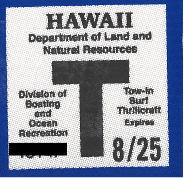
The content of this module is not designed for tow-in surfing certification. This is a prerequisite to the tow-in surfing certification. For information about registering for a tow-in surfing certification class, visit: https://dlnr.hawaii.gov/dobor/.
Snorkeling/Diving/Freediving/Scuba/Snuba
Technically, any activity in the navigable waters of the State in which a person breaks the surface of the water and submerges out of sight will require the use of a dive flag. The navigable waters include all waters from the high wash of the waves on the shore to three miles out to sea.
HAR 13-245-9 Diver’s Flag (relevant to boaters and divers)
- A “diver's flag” as defined by rule and measuring not less than twelve inches by twelve inches shall be required to be displayed on the surface of the water by any person or group of persons engaged in free diving or SCUBA diving.
- A diver's flag measuring not less than twelve inches by twelve inches shall be displayed on the highest point of the main structure of a vessel that is sixteen feet or less in length overall in order to provide an unobstructed view of the diver's flag from all directions when diving from the vessel.
- A diver's flag measuring not less than twenty inches by twenty-four inches, shall be displayed on the highest point of the main structure of any vessel that is greater than sixteen feet in length overall in order to provide an unobstructed view of the diver's flag from all directions when diving from the vessel.
- If snorkeling, free diving, or SCUBA diving is in progress between sunset and sunrise, the diver’s flag shall be clearly illuminated. A diver’s flag is considered clearly illuminated when it is identifiable from at least one hundred feet away.
- There shall be no restriction on subsurface distance from a diver’s flag. However, snorkelers, free divers, and SCUBA divers are prohibited from surfacing more than one hundred feet away from the diver's flag in the ocean waters of the State and more than fifty feet from the diver’s flag in navigable streams, except in cases of emergencies.
- All vessels shall be prohibited from approaching within one hundred feet of a displayed diver's flag or within fifty feet of a displayed diver's flag on navigable streams with the following exceptions:
- Vessels approaching a displayed diver's flag to conduct SCUBA, snorkeling, or free diving activities within the one hundred foot or fifty-foot restricted area shall be allowed to do so provided that the vessel approaches at a speed of slow-no-wake.
- Vessels approaching a displayed diver’s flag navigating through marked navigation channels are exempt from the distance restriction described in subsection (f) but shall proceed at a speed of slow no-wake through the navigation channel when a diver's flag is displayed adjacent to the navigation channel.
Miscellaneous Rules for All Boaters
- No person shall moor a vessel or raft to any waterway marker or aid to navigation placed by the United States or the State in any of the navigable waters of the State.
- Trespassing on someone else’s vessel is illegal. Whoever, without right, boards or remains in or upon any vessel of another within the waters of the State shall be guilty of a misdemeanor.
- No person shall anchor or moor a vessel on the ocean waters or navigable streams of the State surrounding without a permit issued by the department. Recreational or fishing vessels may temporarily anchor for a period of less than seventy-two hours. This three-day period is adequate time to allow owners/operators to visit the appropriate DOBOR District Office and secure an offshore mooring permit.
Deviations From Statewide Rules
Occasionally certain waterways will have different, more restrictive laws than the standards set in other State waters. This is true for the waters off Kaanapali, Maui, for Hanalei Bay, Kauai, Wailua River, Kauai, etc. Here are some examples.
- No person shall operate a vessel at a speed in excess of “slow-no-wake” within five hundred feet of the shoreline, an ingress/egress zone, designated mooring area, or on the Hanalei River (Hanalei Bay and Kaanapali);
- No person shall navigate a motorboat within three hundred feet of a diver’s flag or a designated swimming area (Hanalei Bay);
- No person shall anchor, moor or stay aboard a vessel except those equipped with an approved marine sanitation device (MSD) in good working condition, or those vessels exempt from MSD requirement in accordance with U.S. Coast Guard regulations (Hanalei Bay).
- Water skiing on the Wailua River (Kauai) is restricted to specific zones. In one of the zones water skiing may only be conducted from sunrise to 9am and from 5pm to sunset. Vessels used for water skiing are exempt from speed restrictions in HAR 13-244-9; however, they may not exceed 36 MPH (Wailua River).
Cultural Practices
The Historical, Cultural and Customary Practices of Hawaii’s Ocean Users
For the safety of all, DLNR encourages boaters to learn the specific rules for the waters they use. You can find all Hawaii boating rules, “Administrative Rules” at: https://dlnr.hawaii.gov/dobor/.
The Polynesian ancestors of Hawaii were expert seafarers who relied on the ocean for food, travel, and recreation. Today, the ocean remains central to island life, with activities like surfing the State Individual Sport and outrigger canoe paddling the State Team Sport reflecting this deep connection. These traditions come with unspoken rules to ensure everyone’s safety and enjoyment.
When recreating in Hawaii’s waters, keep these in mind:
- Thrill craft can legally enter surf breaks within designated zones, but manual craft (surfers, paddlers) always have priority. All ocean users should respect each other, take turns, and avoid collisions.
- Many residents fish commercially and recreationally. Noise and vibrations from thrill craft can scare fish away and disrupt fishing. Stay clear of fishing operations to avoid interfering.
- The ocean is busy with people fishing, diving, paddling, and more. Always keep watch, follow dive flag rules, slow down near paddle and wind-powered craft, and be ready to help others in distress.
- Respect more experienced ocean users and avoid aggressive behavior. With new equipment and activities, peaceful coexistence depends on everyone following rules and showing respect.
To earn respect, respect others’ right to enjoy the ocean. Avoid actions that endanger yourself or others and protect Hawaii’s land and sea as precious shared gifts.
Get Certified Online!
Take this Hawaii–approved online boating course to complete your boaters safety education. Boat-ed.com is a delegated provider for the Hawaii Department of Land and Natural Resources.
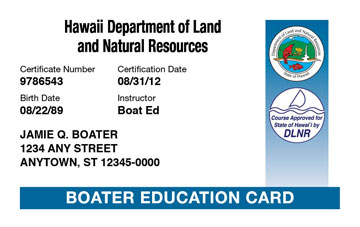
Lifetime Card
Get Certified →
unlimited exam attempts